Deep artsy thought (not mine)

Here are a couple of pithy ideas taken from from the endnotes to Voyage Along the Horizon, by Spanish novelist Javier Marías (written at the age of 21). Longest literate sentences i’ve ever read, by the way.

[The] end of a novel isn’t usually very important. In fact, people never seem to remember the endings of novels … and movies. Conclusions and final explanations are ofter the most irrelevant — and disappointing — parts of a novel. What counts the most — and what we remember the most — is the atmosphere, the style, the path, the journey, and the world in which we have immersed ourselves for a few hours or a few days…. [p. 182]

and

Nowadays, those of us who are writers spend a lot of time expressing our opinions about almost anything that happens anywhere in the world…. We are constantly being asked to take a “position.” or to demonstrate our solidarity with some cause or disaster or problem. For my part I have always made an effort to distinguish between the novelist and the citizen.
As a citizen, I have an opinion about far too many things…, and in this sense I feel very much a part of the world, and quite obligated to become involved in what is happening around me. As a novelist, however, I am not a citizen. In that area, I try to steer clear of judgments, moral codes, and … morals at the end of the story. [p. 180]

.
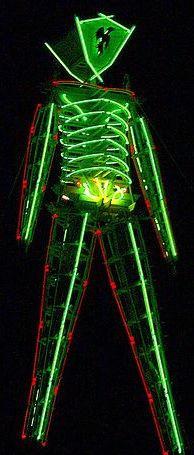
burningmanAnd the following riveting observations (emphases mine) are taken from an interview by Geoff Dyer in MODERN PAINTERS, spring 2003, with Larry Harvey, founder and director, and LadyBee, art curator, of the (in)famous Burning Man festival, held for a week around Labour Day in Black Rock Desert, Nevada, every year since 1986:

LH: The art market is a winner-takes-all system, and there are very few winners. In this country, state support for the arts is almost non-existent so you get a thousand people competing for a tiny bit of money. The ironic thing is that Burning Man has become the largest funder of artists in San Francisco. By making Burning Man a gift economy and treating the artist’s calling as a kind of vocation devoted to gifts we’ve not only been able to give money to artists but have generated a huge amount of communal support for them.

Q: What are you looking for in the artists you choose to support?

LH: The first thing we ask is whether they have a community who can help them and whether they are willing to collaborate with others. Everything in the market drives people away from this kind of approach, because they want to create a unique commodity that has unique value. We ask that the creative process have a social, interactive aspect, and then we ask that the work itself function to convene society around it. That produces a huge amount of social capital, as opposed to normal monetary capital. So in a way we’re creating a new kind of art market which depends on extended social networks that arise around the artists’ gifts.

Q: What was your background, LadyBee, before you started working for Burning Man?

LB: I went to the Art Institute of Chicage and was totally sold on the idea that I’d sell my work and make a living from it. I spent a decade in New York, became disenchanted and moved to San Francisco. Then I went to Burning Man, where artists were renting trucks and hauling huge amounts of material out there at their own expense, and going to huge efforts with crews of helpers to build a piece that would exist only for a few days after which they would actually burn it. This was the most radical thing I had seen artists do. Obviously they weren’t motivated by careers and money — there was something else going on. They had the experience of making the wtork, they had a venue to show it where a lot of people would see it and interact with it, they’d get a lot of feedback from the community, and then the piece would be gone. I hate to use the word ‘pure‘ but it seemed a much purer way of making art.

Urban chic, with a side of Toff

So i’m walking back from the book launch at the planetarium and i think, Hey i should blog this for all those poor saps now staring at their TVs in Tofino for lack of anything better to do, late on a Friday night.

I’m on the corner of Broadway and Kingsway and lo, there before me is the Our Town cafe, open late (Are you listening Tofino? Are you listening Ucluelet?) with free wireless (Are you listening, etc.). So i pop in for a $1.80 (Are you …) ginger vanilla tea and sit at a funky table watching Broadway roll by and blogging about the Vancouver launch of Margaret Horsfield’s Voices from the Sound — Chronicles of Clayoquot Sound From 1899-1928.

Margaret gives good slide, and the planetarium theatre was over half full with, at a guess, 150 people. It was a weird experience to sit in the city, watching a historical picture show of my sorta home town a world away with a room full of … well, who were these people? Grey-haired to a man and woman. Margaret seemed to know several of them so maybe it was the home-town crowd. Maybe it was all those absentee owners whose rampant appetite for condominiums is turning the town upside down. There seemed to be no lack of ready money, for at least a third of the attendees bought a copy of the book. The evening’s proceeds went to The Land Conservancy, more power to Margaret.

And now the tea is drained and i’m off to Commercial Drive, theredown to stroll. Who says you can’t have both urban and rural?

Elder worth hearing

This came out at the Men & the Environment — the next heroic journey conference (Nov. 18 in Victoria). I find it hugely inspiring, and i’ve been carrying a copy around with me since. There are various versions on the net.

A Hopi Elder Speaks

“You have been telling the people that this is the Eleventh Hour. Now you must go back and tell the people that this is The Hour. And there are things to be considered:

“Where are you living?

“What are you doing?

“What are your relationships?

“Are you in right relation?

“Where is your water?

“Know your garden.

“It is time to speak your Truth.

“Create your community. Be good to each other. And do not look outside yourself for the leader.”

Then he clasped his hands together, smiled, and said, “This could be a good time!”

There is a river flowing now very fast. It is so great and swift that there are those who will be afraid. They will try to hold on to the shore. They will feel they are torn apart and will suffer greatly.

“Know the river has its destination. The elders say we must let go of the shore, push off into the middle of the river, keep our eyes open and our heads above water. And I say, see who is there with you and celebrate.

“At this time in history, we are to take nothing personally, least of all ourselves. For the moment that we do, our spiritual growth and journey comes to a halt.

“The time for the lone wolf is over. Gather yourselves! Banish the word struggle from your attitude and your vocabulary. All that we do now must be done in a sacred manner and in celebration.

“We are the ones we’ve been waiting for.”

–attributed to an unnamed Hopi elder, Hopi Nation, Oraibi, Arizona

Spook Country

I recently bought and read seminal Vancouver author William Gibson‘s latest, Spook Country. Gibson is one of the few authors i make a point of following. S.C.’s a good read, if a little gearhead and plodding — the man’s a fanatic for detail, too much detail. But he still has a hawk’s eye for the telling social insight and the signature ideas of the time.

I always collect quotes from books i read (that’s why the pages are always turned down) and here are a few that imrigued me — especially the “cold civil war” and the “fuckedness index.” Emphases mine.

  • He’d once dated a woman who liked to say that the windows of army surplus stores constituted hymns to male powerlessness. (p.19)
    .
  • Alejandro looked over his knees. “Carlito said there is a war in America.”
    “A war?”
    “A civil war.”
    “There is no war in America.”
    “When grandfather helped found the DGI, in Havana, were the Americans at war with the Russians?”
    “That was the ‘cold war.'”
    Alejandro nodded, his hands coming up to grip his knees. “A cold civil war.” (p.47)
    .
  • The most interesting ways of looking at the GPS grid, what it is, what we do with it, what we might be able to do with it, all seemed to be being put forward by artists. Artists or the military. That’s something that tends to happen with new technologies generally: the most interesting applications turn up on the battlefield, or in a gallery.
    .
  • A nation … consists of its laws. A nation does not consist of its situation at a given time. If an individual’s morals are situational, that individual is without morals. If a nation’s laws are situational, that nation has no laws, and soon isn’t a nation. (p.139)
    .
  • Cities, in Milgrim’s experience, had a way of revealing themselves in the faces of their inhabitants, and particularly on their way to work in the morning. There was a sort of basic fuckedness index to be read, then, in faces that hadn’t yet encountered the reality of whatever they were on their way to do. By this standard, Milgrim thought, scanning faces and body language as Brown drove, this place [Vancouver] had an oddly low fuckedness index. (p.262)

Atwood on the art of Harper

Harper’s huge recent cuts to arts programs, along with his remarks about arts being a “niche interest” and “a bunch of rich people at galas whining about their grants,” are a slap in the face to people like me, who devote countless hours to volunteering for the arts and the pursuit of our own artistic endeavours. Harper’s gaffe (as it’s shaping up to be) is a window into the man’s soul, which looks to be a chill and forbidding place to live.

Out of interest i dug up what i could on Harper’s cultural cred. From a Wikipedia article, here’s some background:

  • born in Toronto, father an accountant at Imperial Oil.
  • attended Northlea Public School, John G. Althouse Middle School, Richview Collegiate Institute. Graduated 1978, top of class with 95.7% average.
  • was member of Richview Collegiate’s team on Reach for the Top.
  • enrolled at U. of Toronto but dropped out after two months.
  • moved to Edmonton, worked in Imperial Oil mail room. Later, advanced to work on company’s computer systems.
  • enrolled at U. of Calgary; completed Bachelor’s in economics. Earned Master’s in economics, 1993, thesis on  “the influence of political cycles in the formation of fiscal policy” (according to the 2004 Globe & Mail article Educating Stephen ).

Hmm … not a lot of evidence there for artistic savoire faire. But the article does go on to list some serious cultural chops. Harper:

  • has several hobbies.
  • has participated in many artistic endeavours.
  • is an avid fan of ice hockey and the Calgary Flames.
  • has ventured into sports broadcasting. During TSN broadcast of World Junior Hockey Championships, appeared in interview and expressed views on state of hockey today. Expressed preference for overtime period in lieu of shoot-out.
  • taped cameo appearance in an episode of TV show Corner Gas which aired in 2007.
  • reportedly owns large vinyl record collection.
  • is an avid fan of The Beatles and AC/DC.

Oh, well, okay then — by that measure he’s clearly qualified to both comment on and control (read: “strangle”) the country’s artistic future. However, let’s give a moment to one of our country’s preeminent artists, dagger-tongued author Maggie Atwood, who in a recent Globe & Mail opinion piece (To be creative is, in fact, Canadian) demurs with Harper’s view. Do read the whole thing, but here are the first few paragraphs:

MARGARET ATWOOD

From Thursday’s Globe and Mail

September 24, 2008 at 11:00 PM EDT

What sort of country do we want to live in? What sort of country do we already live in? What do we like? Who are we?

At present, we are a very creative country. For decades, we’ve been punching above our weight on the world stage — in writing, in popular music and in many other fields. Canada was once a cultural void on the world map, now it’s a force. In addition, the arts are a large segment of our economy: The Conference Board estimates Canada’s cultural sector generated $46-billion, or 3.8 per cent of Canada’s GDP, in 2007. And, according to the Canada Council, in 2003-2004, the sector accounted for an “estimated 600,000 jobs (roughly the same as agriculture, forestry, fishing, mining, oil & gas and utilities combined).”

But we’ve just been sent a signal by Prime Minister Stephen Harper that he gives not a toss for these facts. Tuesday, he told us that some group called “ordinary people” didn’t care about something called “the arts.” His idea of “the arts” is a bunch of rich people gathering at galas whining about their grants. Well, I can count the number of moderately rich writers who live in Canada on the fingers of one hand: I’m one of them, and I’m no Warren Buffett. I don’t whine about my grants because I don’t get any grants. I whine about other grants – grants for young people, that may help them to turn into me, and thus pay to the federal and provincial governments the kinds of taxes I pay, and cover off the salaries of such as Mr. Harper. In fact, less than 10 per cent of writers actually make a living by their writing, however modest that living may be. They have other jobs. But people write, and want to write, and pack into creative writing classes, because they love this activity – not because they think they’ll be millionaires.

Every single one of those people is an “ordinary person.” Mr. Harper’s idea of an ordinary person is that of an envious hater without a scrap of artistic talent or creativity or curiosity, and no appreciation for anything that’s attractive or beautiful. My idea of an ordinary person is quite different. Human beings are creative by nature. For millenniums we have been putting our creativity into our cultures – cultures with unique languages, architecture, religious ceremonies, dances, music, furnishings, textiles, clothing and special cuisines. “Ordinary people” pack into the cheap seats at concerts and fill theatres where operas are brought to them live. The total attendance for “the arts” in Canada in fact exceeds that for sports events. “The arts” are not a “niche interest.” They are part of being human.