Men, retreat!

I spent the weekend at a men’s retreat. This bastion of the 1980s and 90s seems to have plummeted in popularity since the millenium (a Google search on “men’s retreat” brings up a scant 434,000 hits), which brings up the burning question “Why?”. Could it be that men are now so bonded and well-adjusted that they no longer need the rituals and self-affirmations of encounter groups. I doubt it!

Still, i found the retreat idea intriguing, especially since it built on a Men & the Environment conference that featured Victoria’s eco-uber-guru Guy Dauncey, whom i’ve wanted to meet for a long time. Man and the (degradation of the) environment . . . call it a hunch, but is there a connection there somewhere? I went to both events.

So the five stages of men’s retreat for me seem to be: trepidation, hope, deliberate participation, fear of hugs and tears, fun, annoyance, bemusement, getting lost in the woods, and hesitant embrasure. (How many is that?) It was an interesting experience. An eclectic 14 guys — no, men, let’s not shy away from the word — many of whom had experienced the movement years before, some drawn to it, some pushed by crises in their lives.

What did we do in those two days? None of your business is my first response. There’s a reason rituals are guarded — their secrecy gives them much of their force. The big surprise for me was realizing that ritual does have power. Heretofore i’d looked upon it as play-acting or metaphor, and assumed that what efficacy it had comes not from the acts themselves but from their attached cultural significance.
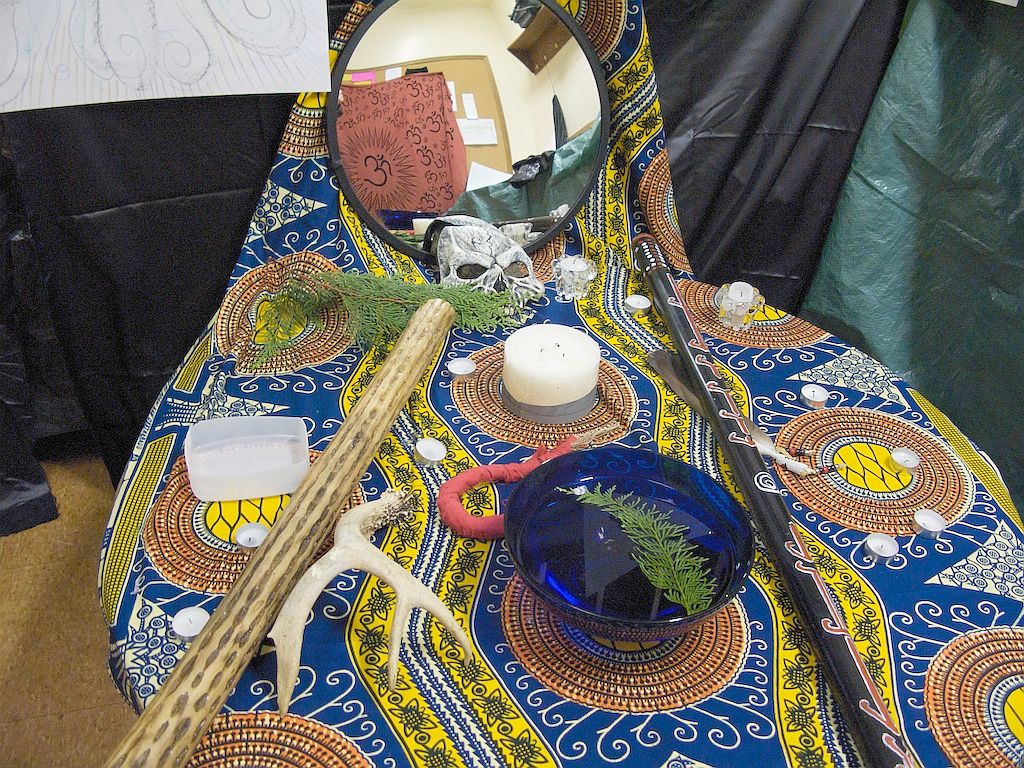
dancing-w-wolves-water-altar
The water altar

I was wrong: the ritual itself induces change in one’s thinking and the conduct of one’s life. And it works in ways that nothing else can. The more i think about it (i’m writing this ten days later), the more i realize the extent to which it has affected me. And the greater my dedication to the arts, which i see as ritual in another guise.

Men’s groups, as it turns out, also come with lots of gushy language and touchy-feely superlatives, to which i am NOT attached in this age of rampant and meaningless exaggeration. (That piece of toast was to die for, it was amazing, it totally changed my life! Pah!) So part . . . much . . . most of my reservations are me being uncomfortable with the physical and the sharing aspect of the weekend. I have pretty much NO experience spilling my guts to men, and that brings with it the correspondingly meager comfort level.

The whole exercise is pretty much one of creating a safe place for men to be with each other in a meaningful way, which is the key. There are plenty of safe places for men — work, the bar, the street, a sports field — but none are particularly meaningful and in none of them do we dare spill our guts or say what’s really on our minds. That’s necessary but almost impossible to find outside of the formal men’s circle.

Would i do it again? I would. I probably will. I might even start organizing a men’s group wherever i end up settling down.

Our three elders/organizers need mentioning:

  • Michael Tacon, of the Well Foundation, grandfathered the whole thing.
  • Dr. Steven Faulkner has run men’s groups as part of his medical practice for decades, and was our principal guide through the long Saturday. A steady hand on the emotional volume control. In his words (kind of telling me off for my cavalier treatment of the rites):

[The] purpose of the rituals was to re-enter our own mythological space and reconnect us individually to our universal nature. Once we reconnect to that, then we can return to the work immediately in front of us. Guy Dauncey reminded us that that there is an urgent need for leadership today. We engage where our higher self intersects with our natural skills.

  • John Shields, ex-priest and current executive director of The Haven (25 years of personal growth courses on Gabriola Island — How could i not have heard about this?‘), wound the weekend up with a striking cosmological perspective of, well, the universe and everything in it. The man has presence. Brought tears to my eyes.

The conference and the retreat were organized by the Well Foundation of Victoria. It was held at the YM/YWCA’s Camp Thunderbird, near Sooke.

Dauncey, incidentally, lives in Saanich, Vancouver Island, and runs  earthfuture.com and puts out the Econews monthly newsletter. If you’ve got those world-in-the-toilet blues real bad, Dauncey’s the pill. (Him and action, at any rate.) The man’s an optimist and a visionary and his uplifting message is oh, so welcome in these dark, dark times. Do yourself a favour and check it out.

A 5-cent story

A woman drives to work in Montreal, on a day like any other. At an intersection near her apartment she stops at a red light and a squeegee kid approaches the car and cleans the windshield. He’s in his late teens, maybe early twenties, and though he looks a little rough around the edges he doesn’t look like a bad kid. She’s seen him a few times before and she never gave him anything, but this time she decides to. All she’s got in the ashtray is a nickel, so she gives him that. He’s not impressed; probably he’s even a bit insulted.

The kid has made this his regular squeegee corner and from that day on she sees him often, almost every day. And every time now, she gives him a nickel. Why a nickel? She figures that it’s something, at least, but it’s not enough for him to go out and buy drugs with.

It goes on for weeks, day after day, weekdays, weekends – whenever they happen to meet at the intersection. She gets rolls of nickels at the bank and keeps them in her car. When he sees her car at the intersection, he heads straight over to clean her windshield and claim his nickel. It’s like they’re friends now; it has become their little joke.

One day she has some time to spare, and maybe he looks a little rougher than usual, so she rolls down the window, gives him a nickel and says, “Would you like me to take you to McDonalds for a meal?”

He hardly hesitates a second before he says, “Yes, I’d like that very much.”

So he gets in, squeegee and all, and they drive to the restaurant for something to eat. They get to talking about his situation, which isn’t a good one, and the woman says, “Would you like some help?”

They talk about that for a while, and then the woman takes out her cell phone and calls a friend of hers who works in a halfway house. Arrangements are made.

After that she doesn’t see him at the intersection anymore, and soon she pretty much forgets about him. The nickels in her car are eventually swept into her purse and spent.

Three months later she’s walking through a mall and a young man walks up to her. She hardly recognizes him, away from the intersection, and he looks a lot different, much more presentable. He recognizes her, though. He has a job now, he says. He has a place to live. And he has something for her, something he’s been carrying around for weeks. He pulls a roll of nickels out of his pocket and gives it to her. They have a good laugh. And then they go on with their lives, feeling a little better about things.

.

The woman is my sister, Rhonda, whose open-hearted acceptance of everybody, foibles and all, is an inspiration to me. I wish i had the savvy that could keep a five-cent joke going for that long, and know that a nickel is sometimes much more than a nickel. She’s an artist of life.

Atwood on the art of Harper

Harper’s huge recent cuts to arts programs, along with his remarks about arts being a “niche interest” and “a bunch of rich people at galas whining about their grants,” are a slap in the face to people like me, who devote countless hours to volunteering for the arts and the pursuit of our own artistic endeavours. Harper’s gaffe (as it’s shaping up to be) is a window into the man’s soul, which looks to be a chill and forbidding place to live.

Out of interest i dug up what i could on Harper’s cultural cred. From a Wikipedia article, here’s some background:

  • born in Toronto, father an accountant at Imperial Oil.
  • attended Northlea Public School, John G. Althouse Middle School, Richview Collegiate Institute. Graduated 1978, top of class with 95.7% average.
  • was member of Richview Collegiate’s team on Reach for the Top.
  • enrolled at U. of Toronto but dropped out after two months.
  • moved to Edmonton, worked in Imperial Oil mail room. Later, advanced to work on company’s computer systems.
  • enrolled at U. of Calgary; completed Bachelor’s in economics. Earned Master’s in economics, 1993, thesis on  “the influence of political cycles in the formation of fiscal policy” (according to the 2004 Globe & Mail article Educating Stephen ).

Hmm … not a lot of evidence there for artistic savoire faire. But the article does go on to list some serious cultural chops. Harper:

  • has several hobbies.
  • has participated in many artistic endeavours.
  • is an avid fan of ice hockey and the Calgary Flames.
  • has ventured into sports broadcasting. During TSN broadcast of World Junior Hockey Championships, appeared in interview and expressed views on state of hockey today. Expressed preference for overtime period in lieu of shoot-out.
  • taped cameo appearance in an episode of TV show Corner Gas which aired in 2007.
  • reportedly owns large vinyl record collection.
  • is an avid fan of The Beatles and AC/DC.

Oh, well, okay then — by that measure he’s clearly qualified to both comment on and control (read: “strangle”) the country’s artistic future. However, let’s give a moment to one of our country’s preeminent artists, dagger-tongued author Maggie Atwood, who in a recent Globe & Mail opinion piece (To be creative is, in fact, Canadian) demurs with Harper’s view. Do read the whole thing, but here are the first few paragraphs:

MARGARET ATWOOD

From Thursday’s Globe and Mail

September 24, 2008 at 11:00 PM EDT

What sort of country do we want to live in? What sort of country do we already live in? What do we like? Who are we?

At present, we are a very creative country. For decades, we’ve been punching above our weight on the world stage — in writing, in popular music and in many other fields. Canada was once a cultural void on the world map, now it’s a force. In addition, the arts are a large segment of our economy: The Conference Board estimates Canada’s cultural sector generated $46-billion, or 3.8 per cent of Canada’s GDP, in 2007. And, according to the Canada Council, in 2003-2004, the sector accounted for an “estimated 600,000 jobs (roughly the same as agriculture, forestry, fishing, mining, oil & gas and utilities combined).”

But we’ve just been sent a signal by Prime Minister Stephen Harper that he gives not a toss for these facts. Tuesday, he told us that some group called “ordinary people” didn’t care about something called “the arts.” His idea of “the arts” is a bunch of rich people gathering at galas whining about their grants. Well, I can count the number of moderately rich writers who live in Canada on the fingers of one hand: I’m one of them, and I’m no Warren Buffett. I don’t whine about my grants because I don’t get any grants. I whine about other grants – grants for young people, that may help them to turn into me, and thus pay to the federal and provincial governments the kinds of taxes I pay, and cover off the salaries of such as Mr. Harper. In fact, less than 10 per cent of writers actually make a living by their writing, however modest that living may be. They have other jobs. But people write, and want to write, and pack into creative writing classes, because they love this activity – not because they think they’ll be millionaires.

Every single one of those people is an “ordinary person.” Mr. Harper’s idea of an ordinary person is that of an envious hater without a scrap of artistic talent or creativity or curiosity, and no appreciation for anything that’s attractive or beautiful. My idea of an ordinary person is quite different. Human beings are creative by nature. For millenniums we have been putting our creativity into our cultures – cultures with unique languages, architecture, religious ceremonies, dances, music, furnishings, textiles, clothing and special cuisines. “Ordinary people” pack into the cheap seats at concerts and fill theatres where operas are brought to them live. The total attendance for “the arts” in Canada in fact exceeds that for sports events. “The arts” are not a “niche interest.” They are part of being human.

Jelly hell

Not to put a damper on your summer’s day, but i just read the following in the July/August 2008 EcoNews newsletter. It’s a downer, no doubt, but i like Victoria’s Guy Dauncey , who publishes the newsletter, because of his irrepressible optimism. In fact, he’ll be getting a good chunk of my $100 climate change rebate from the BC government.

I highly recommend EcoNews as a monthly read — subscribe using the box on the left of the page. And put pressure on our nice Canadian governments, who are dragging their feet in every way possible even as the citizenry forges ahead with grassroots initiatives.

Something extremely disturbing is happening in the world’s oceans. Thanks to our seemingly endless hunger for seafood, we have killed off 90% of the large predatory fish.

There is a consequence to this, since large predatory fish eat other fish — it’s like removing 90% the police from a community. The result in this case is an explosion of jellyfish, since we have killed 90% the sharks, swordfish, tuna, cod, and leatherback turtles that love to eat them.

Holiday destinations in the Mediterranean and Adriatic seas are being plagued with them, in some places as thick as 100 jellyfish per cubic meter of water.

In the US, they are everywhere from Cape Cod to Hawaii.

In May, a mass of jellyfish forced a Japanese nuclear reactor to close down after they blocked its seawater cooling system.

In Northern Ireland, an invasion of non-native mauve stinger jellyfish in a dense pack 10 miles square by 35 feet deep killed 120,000 salmon in a hatchery overnight.

In Namibia, south-west Africa, once one of the most prolific fishing areas in the world, then plundered by the fishing fleets, the jellyfish have moved in and taken over.

Very few fish eat jellyfish, but jellyfish love to eat young larval fish and eggs, making recovery extremely difficult.

“We’re pushing the oceans back to the dawn of evolution, a half-billion years ago when the oceans were ruled by jellyfish and bacteria,” said Jeremy Jackson, a marine ecologist at the Scripps Institution of Oceanography who has dubbed what’s happening as “the rise of slime”.

In addition to us removing their predators, jellyfish thrive in warmer waters — and US and Australian climate researchers reported in June that the world’s oceans have warmed 50% faster over the last 40 years than previously thought, due to climate change.

The only good news is that in the 4% of the oceans that have remained free of human impact, the sharks and predatory fish still dominate, keeping order in the marine world.

The solution is for at least 1/3rd of the world’s oceans to be declared global marine protected areas, with no fishing of any kind allowed. We know from experience in New Zealand and elsewhere that this allows the fish to recover — but time is running out, and global leadership is painfully slow.

Olympic handshake

I don’t usually post political stuff, and i most definitely won’t be posting Olympics stuff, or anything else related to circus-maximus, coliseum entertainment (the new, improved opiate of the masses).

But here’s a clever nexus of the two from the innovative and effective AVAAZ.org activist organization, in the form of an Olympic handshake from the world to China. From the site:

The Beijing Olympics should be a moment to bring citizens around the world together. But the Chinese government still hasn’t opened meaningful dialogue on Tibet, or made progress on Burma and Darfur — and global activists’ messages are too often lost in a firestorm of accusations about being anti-Chinese.

We’ve decided to take the moment back with a powerful, unambiguous message of peace, friendship and dialogue — the Olympic Handshake. The handshake began with the Dalai Lama, passing through the streets of London, now it’s gone online where all of us can join in — help the handshake travel toward Beijing, where our message will be delivered through a big Olympic media campaign before the closing ceremonies. Join the handshake, and see yourself and others as it goes around the globe!

It’s one way to harness the power of the Internet for something beyond porn and email. Go forth and multiplex.