Exciting times

This from the Spiritual Cowgirl site of author Sera Beak. She wrote The Red Book, and is collaborating with B.C. filmmaker Velcrow Ripper, who just released the documentary FierceLight this fall.

This is taken from Beak’s blog post about an interview with Joanna Macy – eco-philosopher and scholar of Buddhism, deep ecology, and systems theory.

Joanna began by describing how our civilization, the industrial growth society, is beginning to unravel — financially, environmentally, politically, psychologically. She said that most people are reacting to this destruction out of fear and obedience or by going numb, but she believes the spiritual challenge is to be present, to truly take in and see what is happening to our world, allow ourselves to open up and feel the pain, mourn the dishonor and destruction and loss, so we are then better able to take action based on the natural compassion that arises in us when we tap into our humanity and connection to the earth. She calls this time period The Great Turning.

There are 3 Dimensions of The Great Turning:

  1. Actions to slow down the destruction being wrought by industrial growth society. These actions are what we generally think of as “activism”. This is a call to protect life and to save as much as you can, but this alone, is not enough.
  2. Planting the seeds for new structures after the old ones fall away, such as alternative fuel, alternative ways of growing and distributing food, alternative health, alternative currency. But, this is also not enough.
  3. A revolutionary shift in consciousness is needed. A sense of awe, gratitude, wonder and devotion to this planet, life, and each other needs to arise from the heart.

Joanna told us there were 3 revolutions in human history:

  1. Agricultural Revolution
  2. Industrial Revolution
  3. This one. While the first two did not require an immense amount of consciousness and had the luxury of time, this Third revolution must be conscious and is happening fast….

In this new consciousness, there is no room for fear or self-criticism. Joanna commented on how we’ve internalized the idea that we’re somehow lacking or not good enough, that we need to buy more, look better, work harder to compete with life. It’s a distraction and false. And yes, sometimes, when we do begin to wake up, we get so overwhelmed by the negative state of the world and how we’ve dishonored this planet and each other that we want to run back to Bloomingdales, our mac and cheese, and Desperate Housewives.

More about the interview, and one with author Tom Robbins, in this archive.

These are exciting times, folks, whether we want it like that or not.

The Recovery Ratio

Here’s a mathematical argument for why you should be working 4 days a week, not 5.

At first glance it doesn’t seem to make that big a difference:

4 days out of 7 = 4/7 = 57% of your days spent working

5 days out of 7 = 5/7 = 71% of your days spent working

The 5-day week only adds 14% more to your burden of work, compared to a 4-day week, but adds 25% more hours  to your workweek, and thus money to your paycheque. Worth it, no?

Short answer: NO. What the simple-minded analysis above doesn’t take into account is the amount of recovery time you get, relative to the amount you work. In other words, the number of days you are ground down by the economic machine versus the number of days you are uplifted by doing your own thing. I call this the Recovery Ratio, and it measures out like so:

recovery-ratio

The “RR” is calculated by the division (recovery days) / (work days). The standard work week gives a baseline ratio of 2/5 = 0.40.

Note what happens when you work a 4-day week with a 3-day weekend — the RR jumps to 0.75, close to twice the baseline ratio. In other words, you get almost twice as much net recovery — plenty to offset the 20% drop in pay you’d have to take.

The RR really starts jumping into the stratosphere when you progress (i chose that word deliberately) to the 3-day and even the 2-day work weeks, which have about three and six times the net recovery as the standard week.

So if you’re finding the standard 5-day work week a bit, well, inhuman, maybe you should consider angling for a 4-day week. Seriously, this thesis has been tested and proven by many experimenters in the field, myself included.

Not to mention that if we are ever going to get this juggernaut of a consumer culture under control, we’re all going to have to shift our priorities to more satisfaction and less stuff. So the 4-day week is the moral thing to do as well!

Honest Abe

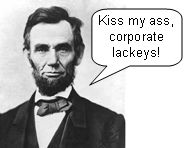
lincolnAlso prescient Abe. This passage appears in a letter from U.S. president (1861-65) Abraham Lincoln to (Col.) William F. Elkins, Nov. 21, 1864. (The war he’s referring to is the American Civil War, but you know how history repeats itself.)

We may congratulate ourselves that this cruel war is nearing its end. It has cost a vast amount of treasure and blood…. It has indeed been a trying hour for the Republic; but I see in the near future a crisis approaching that unnerves me and causes me to tremble for the safety of my country.

As a result of the war, corporations have been enthroned and an era of corruption in high places will follow, and the money power of the country will endeavor to prolong its reign by working upon the prejudices of the people until all wealth is aggregated in a few hands and the Republic is destroyed. I feel at this moment more anxiety for the safety of my country than ever before, even in the midst of war. God grant that my suspicions may prove groundless.

God did not grant, and 144 years later we are living what Abe foretold. I have long felt that reining in the giant multinational corporations will be the enterprise that ultimately decides our collective fate.

Today, thanks to Guy Dauncey‘s laudable EcoNews newsletter, i learned about an interesting take on this: Dr. Riki Ott wrote a book (Not One Drop) calling for a 28th amendment to the U.S. constitution, one that constitutionally separates corporation and state. This would effectively negate the judicial rulings (since 1886 in the states) that corporations have the same rights as human beings, including trial by jury and protection against the taking of property.

Ott was involved with the 1989 Exxon Valdez oil spill disaster in Prince William Sound, which Exxon recently wriggled out of — after nearly 20 years in the courts — with a fine of $507 million. (The original award was $5 billion plus). Exxon’s constitutional protections played a key role in that that legal wrangling. The “suit’s” side of the case is presented in this CNNMoney.com article. From the other side, a 4-minute video by Ott is on YouTube if you’re interested.

Hmm, 20 years in court, Exxon versus a small Alaskan community … you pretty much know how that’s going to turn out.

BUY NOTHING DAY–tomorrow

I dunno where the publicity has gone for this seminal anti-celebration, launched 17 years ago by the visionary ADBUSTERS–journal of the mental environment. Probably buried under the landslide of alarmist press covering the economic meltdown.

But its message is even more relevant today, so ladies and gentlemen, i beg you, keep your wallets closed for one day and contemplate the message that

You are NOT what you buy.

BUY NOTHING DAY

Friday, Nov. 28

bnd08_bg1

My letter to Steve

harper-suck

I caught this CBC story this morning, which begins with the lead:

The Conservatives are poised to eliminate the public subsidies that Canada’s five major political parties receive, a move that would save $30 million a year but could cripple the opposition.

The story, posted last night at 11 p.m., has already garnered some 850 comments, mostly from outraged members of the 66% “minority” who didn’t vote Conservative in the last election (which cost $300 million, in case you’re counting pennies).

Here’s the letter i just dashed off to my esteemed MP James Lunney (nanaimo@jameslunneymp.ca) and cc’d to my doubly esteemed Prime Minister, Stephen Harper (pm@pm.gc.ca):

Dear Mr. Lunney,
Your party’s imminent move to cut taxpayer subsidies to political parties is a deeply cynical political move and a blow against democracy in Canada. The $30 million saved will not make a difference in a recession measured in ten and hundreds of billions, but it will have a strong negative effect on the opposition parties that represented, what, 66% of the country’s voters in the last election. An election that was called somewhat frivolously, I might add, at a cost of $300 million.

Your party’s role as government of the day is to lead, not to use every method at its disposal to cripple the opposition.

Please rethink this sad political ploy and get busy with meaningful work.

Sincerely,

Greg Blanchette
Tofino, B.C.