Time crunch

So i’ve been reading all this spiritual stuff about living in the present, and how “now” is the only time we ever have, and it began to sink in that science is inextricably based on the concept of linear time, starting at t=0 and progressing forward, through the instantaneous slice of the present moment, and ever onward,perhaps infinitely, in its monotonic, plodding, uniform rate.

In contrast, the one incontrovertible aspect of human experience is that, whenever you pause to check, it’s always NOW — a kind of temporal illustration of that old spatial saw, Wherever you go, there you are.

‘S true — you never, ever seem too wake up yesterday, or snap out of a daydream and find it’s tomorrow. Every conscious moment happens at, and only at, t=NOW.

Another obvious disconnect between science and common experience is that “uniform rate” thing. Useful as it has proven for practical purposes like the building of bridges and cell phones and the prediction of lunar eclipses, any 10-year-old can tell you that, experientially, time shoots past quickly when you’re scared or concentrating or having fun, and drags interminably when you, for example, are 10 hours into a 13-hour bus ride from Sault Ste. Marie to Ottawa.

In fact, whatever engrossing psychological state you’re in, while you’re deeply into it time seems to be out of the picture entirely. Only once you lapse back into “ordinary” reality does time seem to have passed quickly or slowly.

After the May meditation retreat in Merritt, i began to idly wonder whether the 2,500-year-old Buddhist assertion that time is an illusion might be an objective, scientific-type fact. I began to wonder what a science based on no-time-but-now could possibly look like.

It would have to be change-based, of course — change is another universal constant noted by those ancient Buddhist scientists. So it would have to include a … trajectory or rate-of-change variable for every single thing embedded in the one-and-only NOW. That seems doable. Where i hit a roadblock is this projection-into-the-future thing, for i realized that science, while it purports to be about knowledge for knowledge’s sake, is really about prophecy: it’s acid test is “experimental verification,” i.e. predicting the future (at least in the limited sense of how matter will behave in controlled experiments). Future prediction is the bread and butter of science, but i see no way to slip or cram it into a futureless NOW. (As i wrote that sentence, though, i got a faint glimmer of how it might conceivably be done.)

In Nelson, a few days after the retreat, it was the work of but half an hour on the library Internet to surprise myself with the discovery that there’s a minor revolution brewing in the fringe corridors of physics, on just this subject. I found at least half a dozen books on the nature of time and the problems this puzzle is creating for physics

Wasn’t till Winnipeg that i got my hands on one of those books: The End of Time: The Next Revolution in Physics, by Julian Barbour. He’s an independent physicist – as he puts it, not tenured by a big university or tethered by a big corporation, and thus able to pursue whatever line of inquiry he pleases, even one challenging as basic and fundamental a common-sense subject as time.

I didn’t finish the book before it had to be returned to the library (alas, time), but got enough of an overview to be intrigued. Physics, according to Barbour, is at an impasse; the macro world of special relativity and the micro world of quantum mechanics both work admirably well at predicting experimental results in their realms, but thus far will not reconcile with each other in any much-sought-after “grand unified theory” — a fatal snag at the heart of which, Barbour and others say, may lie the concept of time.

His proposition is outrageous to contemplate: There is no time, nor is there motion, despite all appearances to the contrary. What there is is an endless series of self-contained NOWs — “time capsules,” he calls them — that each incorporate the characteristics — the mimicry — of time having passed. Our consciousness makes the leap that time has passed, in the same way our eyes and brain construct the illusion of motion from 24 still frames per second at the movies.

Now i’m already beyond my depth, but Barbour invokes another ancient Zen chestnut about the misconceptions we hold about supposedly fixed matter. (The molecules that make up “your” hand are 99% empty space. “Your” blood cells are dying and replacing themselves at a rate of 400 million million a second. Given this emptiness and endless flux of your component matter, how fixed and enduring can “you” really be?)

What’s most interesting is how the mystery of consciousness creeps in here, somehow possibly mediating in what we conceitedly think of as the “objective reality” of things (just like mystics have been incomprehensibly claiming for ages). New-age types will have heard this idea before, but those assertions seem to be on the level of games. Who really operates day-to-day on this level of impermanence?

The end of time, one of our most basic preconceptions about the world, would probably change everything — physics, science, and most significantly the zeitgeist, in unfathomable ways, the way relativity has slowly soaked into the collective unconscious.

I’ve blathered long enough. The field, at any rate, is rich for further, mind-bending reading. Last week i serendipitously discovered that CBC’s Ideas series did a show on this topic, including an interview with Barbour and other speculators. (Click to listen.)

And now we’ve entered the outskirts of Ottawa at last, and i’m looking forward to some urban excitement. Timewise, though, my job — my function on earth, the only thing that seems to hold any enduring interest for me — is to settle firmly into t=NOW.

Mental noise

Eckhart Tolle starts out his CD lecture Through the Open Door with the following:

You didn’t come here to be fed new thoughts, concepts, ideas. Perhaps a few signposts, they are useful. But you didn’t come here to collect more signposts, which say “Rome,” or “Mecca,” or “Enlightenment,” and then carry them home, put them in your library or living room: “Isn’t that a beautiful signpost?” Or worship the signpost — a concept, an idea, a thought. In a way that’s why you are here so that the opposite of that can happen: a relinquishing of concepts and ideas.

Ultimately … relinquishing thought. What is stillness other than the state of consciousness that is free of noise?

.

Ah, mental noise. I can conjure up the most real and alarming nervousness — gut-gripping, esophagus-tightening, and who knows what other physiological symptoms if i cared to inventory them — simply by thinking about … well, here are two items on my mind at the moment:

  • ONE — Ever since i tried at age 16 to hitchhike across Canada, and was defeated by that endless stretch of empty road north of Lake Superior, and gave up and retreated to Winnipeg to fly home to Montreal, this very route i am bussing at the moment has intimidated me. Who hasn’t heard the stories of being stranded in Wawa, that travellers’ wasteland, the very embodiment of purgatory, if not hell itself, for the nervous traveller like me, who is, even as i scribble these notes, en route to that selfsame, broken-promised land.
    It’s a 10-hour Greyhound marathon on a crowded bus with few rest stops. Ever since i left Vancouver with Montreal in mind, this stretch has loomed large in my mind. Can i survive it? How will i be affected by sitting on my ass for this long? Blood clots in my legs? Will i go mad, leaping from the bus on some lonely curve, never to be heard from again?
  • TWO — But that’s kid stuff compared with the gut-stab i can give myself by turning my thoughts to my looming return to the West Coast. At that point i’ll no longer be able to put off the issue of what i’m going to do with myself. I have some time (= money) saved up, so i won’t have to rush into some noxious job just to stay fed. That’s a mercy, but it’s a time-limited mercy and i cannot forget that making a living will reassert itself sooner or later.
    For me, though, the gripping issue is where i am going to live, which will have a seminal influence over everything else.
    My present state of homelessness is not a comfortable one, a fact especially highlighted for me after a month in the retirement complex that now passes for the familial home, where i can crash with a modicum of belonging. Anywhere and everywhere else in the world for me now, it’s imposing on friends (if i’m lucky) or night-by-night, at a nightly rate that will make short work of those aforementioned savings.
    It’s the work of finding a home that scares me most: that element of competition with other prospective tenants, that creepy interview process in a shared house (my preferred option). I don’t have a large network of friends to tap in finding a place, i’m not interested in adopting the upbeat “people” energy to make the interviewees pick me, pick me! But you gotta sleep somewhere, damn it, put your stuff somewhere. So i’ll need a place. And thinking (or rather, worrying) about that really cranks me up.

.

But that’s all in imagination land at the moment. Here’s the apparent truth from the here-and-now of my situation: I’m in a comfortable, if pinched, aisle seat halfway back on Greyhound coach #973, hurtling smoothly eastward beneath an unveiled sun, overlooking mile after mile of heartbreakingly beautiful, wild, coruscating Lake Superior shore. I’m not hungry, though i have a bag full of good food if i get that way, and although i’m going to want to get out and stretch and walk around pretty soon, life is damn good.

There is, of course, the young man sitting next to me to consider. He’s Middle Eastern, i think, and hasn’t said a single word in five hours despite my conversational overtures, and he seems to be praying to Allah in his seat more often than strictly necessary. He has no watch, no carry-on, no hat or clothes apart from what he’s wearing, and apparently no luggage, as though he has nothing to carry, nowhere to go — conceivably because he may well have a suitcase full of explosives down in the luggage compartment under the bus, set with a timer to go off at 12 noon exactly, and here it is 11:56, and life is sweet, and maybe i have four short minutes to live, and lord knows this is all in my head but i feel my gut churning about it nonetheless and yessir, here we go again….

Mad person, social menace, intellectual criminal

This is turning, serendipitously and by design, into a Year of Dangerous Ideas for me, and i must say, it’s thrilling.

These days i’m listening heavily to the lectures of one Terence McKenna, to whom i was introduced by former Toff-boy S-Ray Jay while heading north in his right-hand-drive Delica en route to a honey farm to collect dead bugs for some nefarious purpose.
McKenna’s a relic from the psychedelic 60s, except that, far from being an addled drug burnout, he strings radical and deeply subversive ideas together with a facility that argues well for alien intelligence. Here are a few of many, many galvanizing words from his 1987 lecture, Light of Nature (part 3, abut 42 minutes in):

[W]hat is really happening is a return to the primacy of feeling, and feeling is not something you can convey to people the way you convey facts to them. Facts can be handed down every week through Time magazine and the latest of Science News and Nature. But feelings will not lend themselves to that marketable, hierarchically distributed system. And consequently feelings represent a back[lash] against that.

Yet feeling is the modality in which we all operate. So as long as we are under the umbrella of the print-created, linear, post-Medieval institutions that promote the myth of the public, the notion of the atomic individual, the notion that we are all basically alike, then we are going to be unempowered.

Just so you know what you’re getting into if you decide to pursue McKenna’s ideas, he precedes that paragraph with the following:

The answer to self-empowerment lies in the psychedelic experience. The answer to dissolving the hierarchically imposed set of mythical conventions that disempower us lies in the psychedelic experence.

Whew! You hear enough of this (and i’m on about my ninth hour of listening and relistening) and you want to start crawling around in the forest looking for mushrooms.

Instead, though, i’m going to crawl around the Sunday wilds of Thunder Bay, looking for the transcendence of breakfast and a good café.

.

There’s a wealth of audio material available on-line if you google up “terence mckenna audio“. I started here.

And lest the man be considered a fringe lunatic or pleasure-seeker, here’s a quote (from the Wikipedia article) that shows him to be pretty gounded:

It’s clearly a crisis of two things: of consciousness and conditioning. These are the two things that the psychedelics attack. We have the technological power, the engineering skills to save our planet, to cure disease, to feed the hungry, to end war. But we lack the intellectual vision, the ability to change our minds. We must decondition ourselves from 10,000 years of bad behavior. And, it’s not easy.
—Terence McKenna, “This World … and Its Double”

Can you believe what you see?

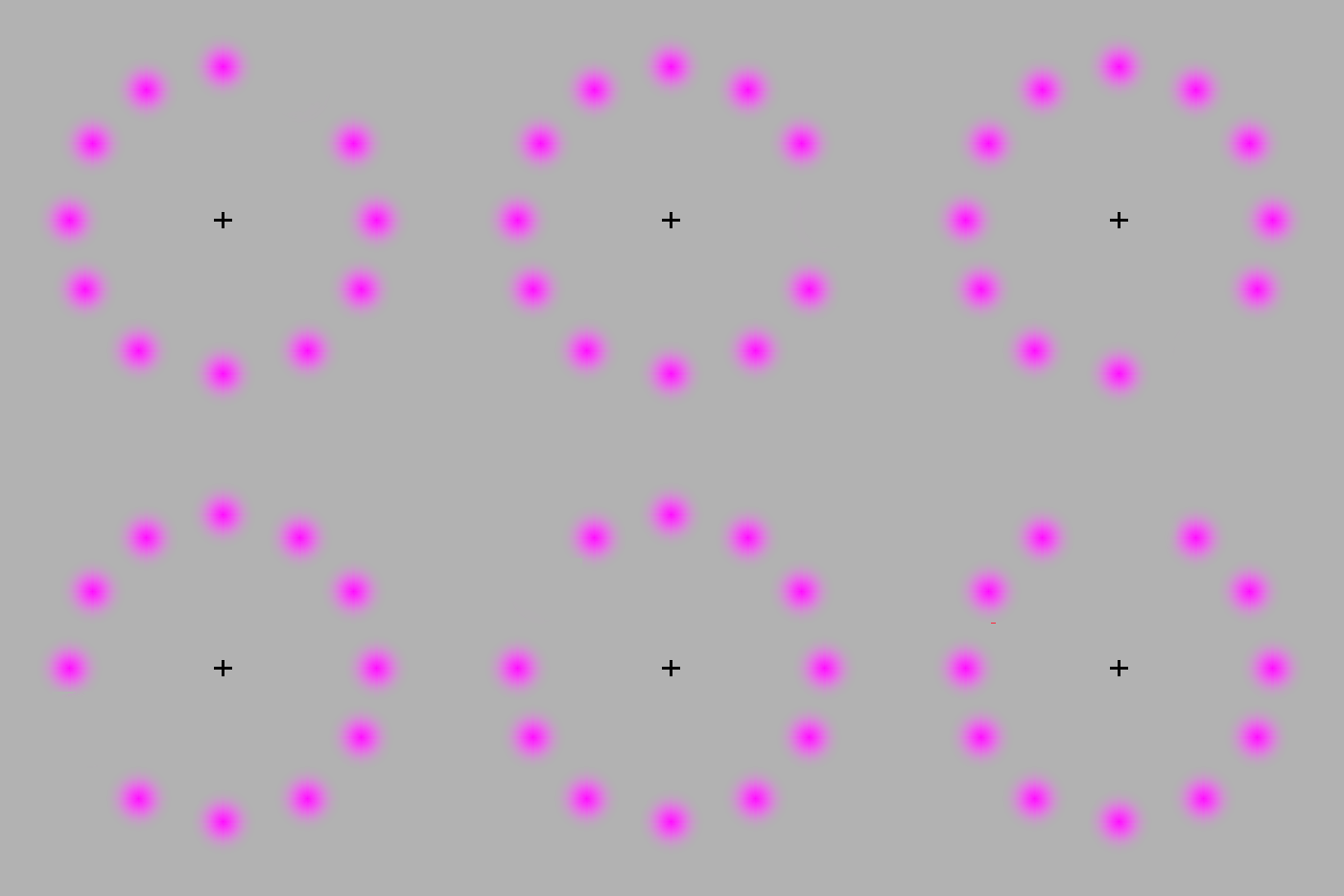
Stare at the + sign till the dots disappearClick on the thumbnail to display the full-size image.

Stare at the plus sign in the middle for about a dozen cycles, and watch how what you see changes, and changes again. It’s all about the green dot; oddly, there is no green dot.

Sorta makes me wonder what i walk by and “see” every day, or walk by and do not see. The world is a mysterious place.

Self-definition

I’m wallowing in a funk of self-definition these days, or rather, a funky lack of self-definition. The principal building block of the self, in my culture, is what you fill in the blank with in the sentence “I am a _____.” And i have little these days, and seemingly less day by day, with which i feel i can fill that blank. At times, the most suitable gloss seems to be: I am a blank. Which can leave me feeling rather empty and useless.

Oh, there’s plenty i want to full the blank with, or feel i ought to fill it with. “Writer” is a big one — t’would be great to pontificate to the masses as one’s job, one’s outre (but still respectable) social function, treading those delicious lines between fame and influence and privacy.

Then there’s “environmental activist,” “entrepreneur,” “Zen adept,” “teacher,” “drummer,” “performance poet,” and more. I have yearnings in all these directions, and ability and potential. What i don’t seem to have is the je ne sais quoi — discipline, maybe, or narrowness — to latch onto one of them and hang on long enough to, with luck, establish a blank-filling reputation, if only in my mind. (But then, my mind is every mind, in that i’m the perfect reflection of my surroundings.) So i pick up one of them for a while, when the spirit moves me; but then the spirit moves on and i’m floundering again.

Strangely, the main flounder factor is not so much aimlessness as being restless with the aimlessness — the feeling that life is zooming by and i’m not engaging with it, in the beer-commercial or adventure-race sense (where every moment is jam packed with whole-hearted FUN or riveting ACTION or even simple, bone-deep HAPPINESS).

Bah. Written down, this puling limns its own “solution.” It’s written down right here in the box, compleat:
.
Simple, no?