Jesus got it goin’ on

happyjesus1There are very few words of Jesus actually quoted in the Bible, and the meaning and intent of those words seems to hold little sway over the bretheren. Here’s my favourite J-say:

Therefore I say to you, do not worry about your life, what you will eat or what you will drink; nor about your body, what you will put on. Is not life more than food and the body more than clothing?

Look at the birds of the air, for they neither sow nor reap nor gather into barns; yet your heavenly Father feeds them. Are you not of more value than they?

Which of you by worrying can add one cubit to his stature?

So why do you worry about clothing? Consider the lilies of the field, how they grow: they neither toil nor spin; and yet I say to you that even Solomon in all his glory was not arrayed like one of these.

Now if God so clothes the grass of the field, which today is, and tomorrow is thrown into the oven, will He not much more clothe you, O you of little faith?

Therefore do not worry, saying, ‘What shall we eat?’ or ‘What shall we drink?’ or ‘What shall we wear?’

For after all these things the Gentiles seek. For your heavenly Father knows that you need all these things.

But seek first the kingdom of God and His righteousness, and all these things shall be added to you.

Therefore do not worry about tomorrow, for tomorrow will worry about its own things. Sufficient for the day is its own trouble.

–Matthew 6:25-34

The Tofino curse

I’m getting a smattering of emails like the following from friends in Tofino. (Details altered to protect the …  accomplices?)

Hi greg,
A friend of mine has an apartment, it’s a new one near [location in Tofino]. Its not a bad deal, $1,200 plus utilities that run $100-150. It’s set up nicely for two people — two bedrooms & a bathroom upstairs, bedroom & bathroom downstairs. Faces south, catches a lot of sun. It feels warm. Not furnished. Its cheap with a roommate, and it’s long term!

–[Friend]

Now for …the math

Let’s go way, way out on a limb here and assume i actually want to work full-time, 40 hours a week. An optimistic local year-round wage would be, say, $11 an hour — a bit low for the summer, perhaps, but a reasonable average year-round. This yields a gross income of:

$11 x 40 hrs/wk x 52 wks/yr = $22,880 per year.

I haven’t been in that stratospheric wage bracket for years, but at a guess it’d come with, what, a 25% tax rate, leaving a net of $17,100 a year or $1,425 per month.

The accepted cost of affordable shelter (i.e. paying other people’s outrageous mortgages) is widely cited to be about 1/3 of your annual gross. The government’s BC Housing site provides the following info:

Financial support for subsidized housing is generally administered based on “rent-geared-to-income.” Rent-geared-to-income is for low- to moderate-income households. Tenants pay rent based on the gross income of the household rather than paying the market rate. Affordable rent is defined as costing no more than 30% of a household’s total gross monthly income….

So in my hypothetical case, an affordable rent would be $ 22,880 gross x 30% = $6,864/year or $572 per month.

The cost of shelter in the aforementioned apartment, assuming i could find a reliable year-round roommate, would run to at least $675 a month with utilities (not including phone, Internet, cable), or $8,100 a year — 18% above the “affordable” rate.

It also means that 47% of my take-home pay would go to shelter, leaving another $725 a month with which to feed, cloth and entertain myself — not to mention save toward a house purchase (hah!) and my retirement (double hah!).

Factor in that i have zero interest in working a full-time, low-wage tourism job and you can see why i’m camping here on a friend’s floor in Vancouver, trying to figure out how to make the move to Tofino possible.

Thanks, amigos, and keep your eyes peeled for me!

If you have any comments on the above calculations, please make a comment by clicking the “comment” link above.

‘Tis the season, groaned the Earth

no-giftHere at Aimless Ranch, we’re preparing to get and give our usual roster of gifts this Christmas season: nothing at all for or from anybody. I don’t advocate that for everyone. But please, in these sensitive environmental times, if you’re going to indulge, please think about what you buy and its effect on the bigger picture.

Based on an article in the shrill and inimitable Republic of East Vancouver newspaper, here are some worthy suggestions for alternative gift-giving.

  1. Memberships — the gym, the RES, the Botanical Gardens, or some other worthy facility about town.
  2. Classes — music lessons, yoga sessions, karate, pottery studio time, or anything put on by our WestCoast rec departments.
  3. Fab food — organic chocolate, artisan jams and honeys, homemade pie, killer coffee.
  4. Local art, created by people you pass on the street every day.
  5. Sports gear — running shoes, hockey sticks, rain gear, camping supplies.
  6. Vintage rags from the second-hand shops in town.
  7. Gift certificates for your favourite shop in town.
  8. Donations or memberships to organizations you know the giftee would support — the Friends of Clayoquot Sound, the arts society, the streamkeepers … pick a cause!

More suggestions? Leave ’em in the comments below.

Deep artsy thought (not mine)

Here are a couple of pithy ideas taken from from the endnotes to Voyage Along the Horizon, by Spanish novelist Javier Marías (written at the age of 21). Longest literate sentences i’ve ever read, by the way.

[The] end of a novel isn’t usually very important. In fact, people never seem to remember the endings of novels … and movies. Conclusions and final explanations are ofter the most irrelevant — and disappointing — parts of a novel. What counts the most — and what we remember the most — is the atmosphere, the style, the path, the journey, and the world in which we have immersed ourselves for a few hours or a few days…. [p. 182]

and

Nowadays, those of us who are writers spend a lot of time expressing our opinions about almost anything that happens anywhere in the world…. We are constantly being asked to take a “position.” or to demonstrate our solidarity with some cause or disaster or problem. For my part I have always made an effort to distinguish between the novelist and the citizen.
As a citizen, I have an opinion about far too many things…, and in this sense I feel very much a part of the world, and quite obligated to become involved in what is happening around me. As a novelist, however, I am not a citizen. In that area, I try to steer clear of judgments, moral codes, and … morals at the end of the story. [p. 180]

.

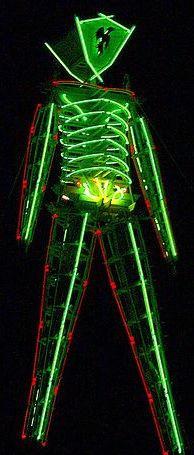
burningmanAnd the following riveting observations (emphases mine) are taken from an interview by Geoff Dyer in MODERN PAINTERS, spring 2003, with Larry Harvey, founder and director, and LadyBee, art curator, of the (in)famous Burning Man festival, held for a week around Labour Day in Black Rock Desert, Nevada, every year since 1986:

LH: The art market is a winner-takes-all system, and there are very few winners. In this country, state support for the arts is almost non-existent so you get a thousand people competing for a tiny bit of money. The ironic thing is that Burning Man has become the largest funder of artists in San Francisco. By making Burning Man a gift economy and treating the artist’s calling as a kind of vocation devoted to gifts we’ve not only been able to give money to artists but have generated a huge amount of communal support for them.

Q: What are you looking for in the artists you choose to support?

LH: The first thing we ask is whether they have a community who can help them and whether they are willing to collaborate with others. Everything in the market drives people away from this kind of approach, because they want to create a unique commodity that has unique value. We ask that the creative process have a social, interactive aspect, and then we ask that the work itself function to convene society around it. That produces a huge amount of social capital, as opposed to normal monetary capital. So in a way we’re creating a new kind of art market which depends on extended social networks that arise around the artists’ gifts.

Q: What was your background, LadyBee, before you started working for Burning Man?

LB: I went to the Art Institute of Chicage and was totally sold on the idea that I’d sell my work and make a living from it. I spent a decade in New York, became disenchanted and moved to San Francisco. Then I went to Burning Man, where artists were renting trucks and hauling huge amounts of material out there at their own expense, and going to huge efforts with crews of helpers to build a piece that would exist only for a few days after which they would actually burn it. This was the most radical thing I had seen artists do. Obviously they weren’t motivated by careers and money — there was something else going on. They had the experience of making the wtork, they had a venue to show it where a lot of people would see it and interact with it, they’d get a lot of feedback from the community, and then the piece would be gone. I hate to use the word ‘pure‘ but it seemed a much purer way of making art.

“Sound” for all

This came up at the book launch two days ago, when someone asked Margaret about the nautical definition of “sound” (her title being Voices from the Sound). She couldn’t say, nor could anyone else in the audience. In the interests of ready reference, i thought i’d put it down here. I don’t have my precious Canadian Oxford to hand (somebody who does, please plug it into the comments below!), but here’s some on-line elucidation:

Dictionary.com says, among several other meanings:

sound –- noun  1. a relatively narrow passage of water between larger bodies of water or between the mainland and an island: Long Island Sound.
2. an inlet, arm, or recessed portion of the sea: Puget Sound.
3. the air bladder of a fish.
Origin: bef. 900; ME; OE sund act of swimming; akin to swim

Excerpted from the Wikipedia page:

In geography a sound or seaway is a large sea or ocean inlet larger than a bay, deeper than a bight, wider than a fjord, or it may identify a narrow sea or ocean channel between two bodies of land (see also strait)….
There is little consistency in the use of ‘sound’ in English-language place names….
A sound generally connotes a protected anchorage.

I’m still looking for some official nautical definitions.

POSTSCRIPT: Compulsive research maven Heather delved into the Canadian Oxford for an entry that, alas, seems no more germane to Clayoquot or Barkley Sounds than either of the above. Here goes:

sound –- n. 1. a narrow channel or stretch of water, esp. one between the mainland and an island or connecting two large bodies of water.
2. an arm of the sea.